
For much of fantasy history, orcs occupied a predictable role. They were the invading armies, the raiders beyond civilization, and the monsters heroes were expected to defeat. Readers rarely learned about their cultures, beliefs, or motivations because those details were considered unnecessary. Orcs existed primarily as obstacles standing between the protagonist and victory.
Modern fantasy has dramatically changed that approach.
Today, orcs are increasingly portrayed as heroes, leaders, revolutionaries, scholars, and survivors. Rather than serving as one-dimensional antagonists, they have become some of the genre’s most compelling characters. This transformation reflects broader changes in fantasy storytelling and helps explain why orc-centered novels continue to grow in popularity.
The question is no longer whether orcs can be heroes. For many readers, they already are.
The Traditional Orc
Early fantasy often relied on clear distinctions between good and evil.
Heroes represented order, civilization, and virtue. Villains represented chaos, destruction, and danger. Orcs frequently occupied the villainous side of that equation, appearing as faceless enemies who threatened the safety of the world.
These portrayals worked well in stories built around straightforward conflicts, but they left little room for nuance. Orcs rarely received individual personalities, and readers seldom experienced events from their perspective.
As fantasy evolved, many authors began questioning whether an entire race should be reduced to a single role.
Readers Wanted More Complexity
One of the biggest changes in modern fantasy has been the demand for more complex characters.
Readers increasingly prefer stories where motivations matter and where conflicts are shaped by competing perspectives rather than simple notions of good and evil. This shift encouraged authors to explore races that had previously been treated as stereotypes.
Orcs became a natural choice.
What if the supposed monsters had families, traditions, and histories of their own? What if their actions made sense when viewed from their perspective? What if they were not villains at all?
These questions opened the door to a completely different kind of fantasy story.
Orcs Became People Instead of Monsters
The most important development in modern orc fantasy is that authors began treating orcs as people.
They created cultures.
Religions.
Governments.
Languages.
Families.
Rather than existing solely to fight heroes, orcs became fully realized societies with their own strengths, flaws, ambitions, and struggles.
This change allowed readers to connect with orc characters on an emotional level. Once readers began seeing the world through their eyes, it became much harder to view them as inherently evil.
The result was a dramatic reimagining of one of fantasy’s oldest races.
The Rise of Orc Protagonists
Another major factor behind this transformation is the growing popularity of orc protagonists.
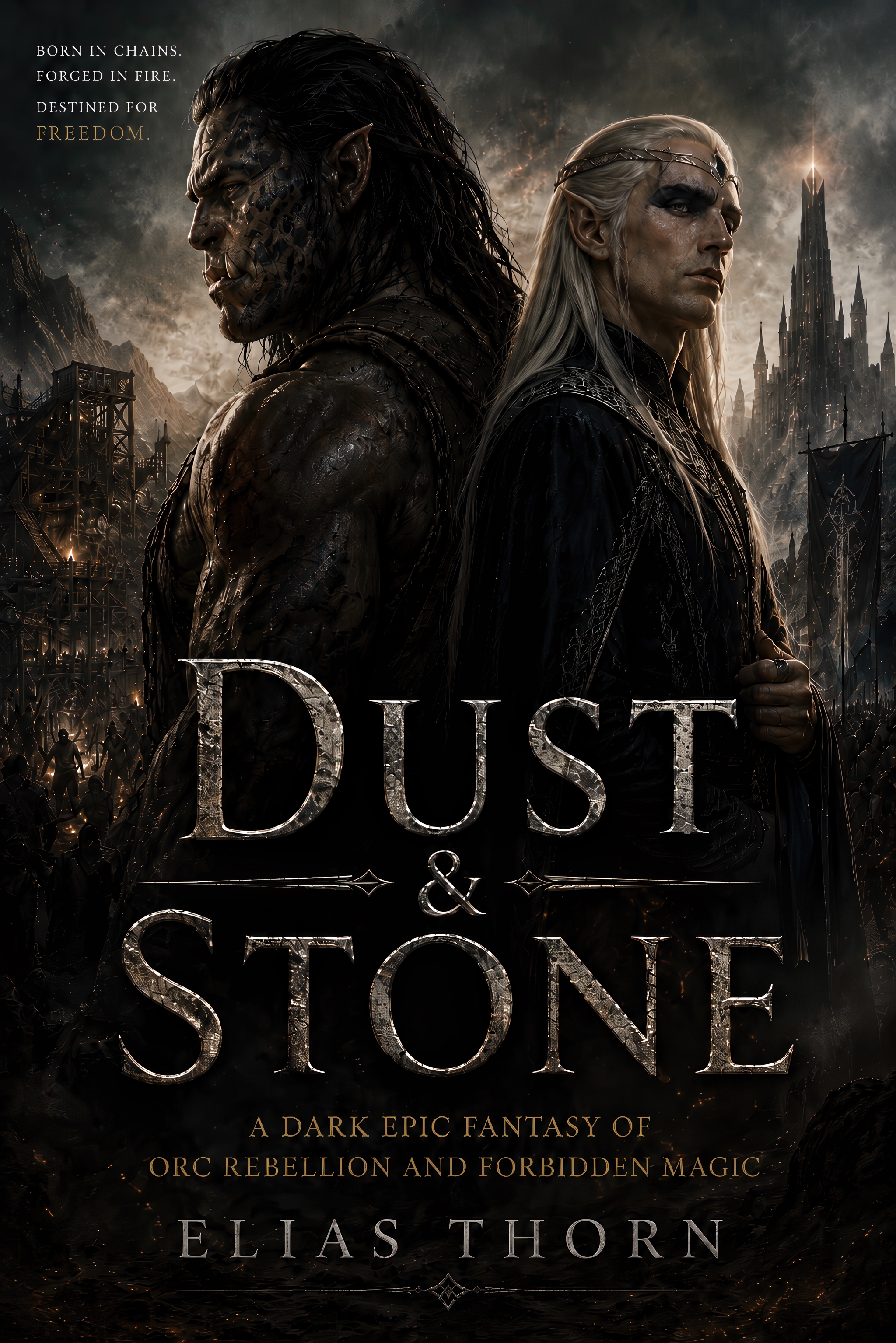
Books such as Orcs, The Grey Bastards, and Dust & Stone place orc characters at the center of the narrative. Instead of fighting against them, readers follow their journeys, experience their hardships, and understand their motivations.
This perspective changes everything.
When readers spend hundreds of pages alongside an orc protagonist, they begin seeing the world from a completely different angle. Conflicts become more complicated. Villains become less obvious. Questions of identity, freedom, and survival take center stage.
The race that once served as a generic antagonist becomes the emotional heart of the story.
Dust & Stone and the Orc Perspective
A powerful example of this shift can be found in Dust & Stone.
The novel follows the Kethri, a once-proud race of orcs who have spent fifty years enslaved beneath the mountains by the elven Dominion. Their language has been outlawed, their traditions suppressed, and their history systematically erased.
Rather than portraying the orcs as a threat, the story presents them as victims of conquest struggling to preserve their identity.
At the center of the narrative is Vorrick, whose personal tragedy forces him to confront difficult questions about freedom, leadership, and sacrifice. Through his journey, readers experience the consequences of oppression and the challenges of resistance from the perspective of those who have lost everything.
The novel demonstrates how dramatically fantasy has changed. Instead of asking whether the orcs are evil, readers are asked to consider what happens when an entire culture is denied the right to exist on its own terms.
👉 Learn more about Dust & Stone: https://a.co/d/0hGuId6e
Modern Fantasy Challenges Stereotypes
Fantasy has become increasingly interested in questioning assumptions.
Many authors now explore themes of prejudice, colonization, identity, and cultural survival. Orcs are particularly well suited to these stories because they have historically been portrayed as outsiders.
By challenging old stereotypes, authors create richer and more meaningful narratives. Readers are encouraged to look beyond appearances and consider how history, power, and perspective shape the way societies view one another.
These stories often feel more realistic because they acknowledge that conflicts are rarely as simple as they first appear.
Why Readers Connect With Orc Heroes
Orc protagonists often embody qualities that readers admire.
They are resilient.
Determined.
Loyal.
Resourceful.
Many begin their stories as underdogs facing enormous obstacles. They must overcome prejudice, survive difficult circumstances, and fight for futures that seem impossible.
These struggles create strong emotional investment because readers naturally want to see them succeed.
Their victories feel earned, and their failures feel meaningful.
Villains Still Exist—But They Are Individuals
Modern fantasy has not eliminated villainous orc characters.
Instead, it has changed how villainy is portrayed.
Rather than suggesting that all orcs are evil, contemporary stories generally treat morality as an individual matter. Some orcs become heroes. Some become villains. Many occupy morally gray territory somewhere in between.
This approach creates more believable characters and allows for greater storytelling flexibility.
Readers can no longer predict a character’s role simply by looking at their race.
The Future of Orc Fantasy
The growing popularity of orc-centered stories suggests that this evolution is far from complete.
Authors continue finding new ways to explore orc cultures, histories, and perspectives. Future stories will likely expand even further, examining topics such as politics, diplomacy, exploration, religion, and family life.
The possibilities are far broader than they once were.
What began as a simple fantasy archetype has become one of the genre’s most versatile storytelling tools.
Final Thoughts
Orcs are no longer fantasy villains because fantasy itself has changed.
Readers increasingly seek complex characters, nuanced conflicts, and stories that challenge traditional assumptions. Authors have responded by transforming orcs from faceless enemies into fully realized individuals capable of heroism, wisdom, sacrifice, and leadership.
Books like Dust & Stone showcase the best of this evolution. Through the story of Vorrick and the Kethri, readers experience a powerful narrative about freedom, cultural survival, and the fight to reclaim a stolen identity.
In modern fantasy, the most interesting question is no longer whether orcs are villains.
It is what kind of heroes they might become.
👉 Get your copy of Dust & Stone: https://a.co/d/0hGuId6e
Frequently Asked Questions
Are orcs still villains in fantasy?
Sometimes, but modern fantasy increasingly portrays orcs as heroes, leaders, and complex individuals rather than inherently evil races.
Why were orcs originally portrayed as villains?
Early fantasy often relied on clear distinctions between heroes and enemies, and orcs frequently filled the role of antagonists.
What books feature heroic orcs?
Examples include Dust & Stone, The Grey Bastards, Orcs, and several Warcraft novels.
Why do readers enjoy orc protagonists?
Readers appreciate their unique perspectives, underdog narratives, emotional depth, and themes of resilience and identity.
Does Dust & Stone portray orcs as heroes?
Yes. The novel centers on the Kethri, an oppressed orc civilization fighting to reclaim its freedom and cultural identity.
Leave a Reply