
For much of fantasy history, the answer to the question “Are orcs evil?” seemed straightforward.
Orcs were often portrayed as villains, raiders, invaders, and monsters whose primary purpose was to oppose the heroes of a story. They appeared as faceless armies marching under dark banners, serving evil rulers and threatening civilized lands.
Modern fantasy, however, has dramatically changed the conversation.
Today’s fantasy authors increasingly reject the idea that an entire race can be inherently good or evil. Instead, they create complex orc cultures, sympathetic protagonists, and morally nuanced societies that challenge readers to reconsider long-held assumptions.
As a result, one of fantasy’s oldest questions now has a much more complicated answer.
Why Orcs Were Traditionally Viewed as Evil
Early fantasy often relied on clear distinctions between heroes and villains.
Readers knew who to support because the moral lines were clearly drawn. Orcs frequently occupied the role of antagonists because they represented danger, chaos, and conflict.
These portrayals worked well within stories built around epic battles and straightforward struggles between good and evil.
The problem was that orcs were rarely given individual personalities, cultures, or motivations. They existed primarily as obstacles for heroes to overcome rather than as fully developed characters.
Because readers rarely saw events from their perspective, it was easy to view them as inherently evil.
The Problem With Labeling Entire Races
As fantasy matured, many authors began questioning the idea that morality could be assigned to an entire race.
After all, if humans, elves, dwarves, and other fantasy races contain both heroes and villains, why should orcs be different?
This shift encouraged writers to examine orc societies more closely.
What values do they hold?
How do they govern themselves?
What traditions and beliefs shape their culture?
What happens when readers see the world through their eyes?
Answering these questions transformed orcs from monsters into people.
Modern Fantasy Sees Orcs Differently
Today’s fantasy literature often portrays orcs as complex individuals shaped by their circumstances rather than their race.
Some are warriors.
Some are leaders.
Some are scholars.
Some are heroes.
Others are villains.
In other words, modern fantasy increasingly treats orcs the same way it treats every other race.
Their morality depends on their choices rather than their species.
This approach creates richer stories because it allows authors to explore themes of prejudice, identity, and cultural misunderstanding.
When Orcs Become the Heroes
One of the most significant changes in modern fantasy is the rise of orc protagonists.
When readers experience a story through an orc’s perspective, it becomes much harder to accept simplistic stereotypes.
These characters often face discrimination, oppression, and assumptions about who they are. Their struggles mirror many of the themes that make fantasy compelling: resilience, courage, loyalty, and the search for belonging.
By placing orcs at the center of the narrative, authors encourage readers to question traditional fantasy assumptions.
The result is a more nuanced understanding of both the characters and the worlds they inhabit.
Dust & Stone and the Orc Perspective
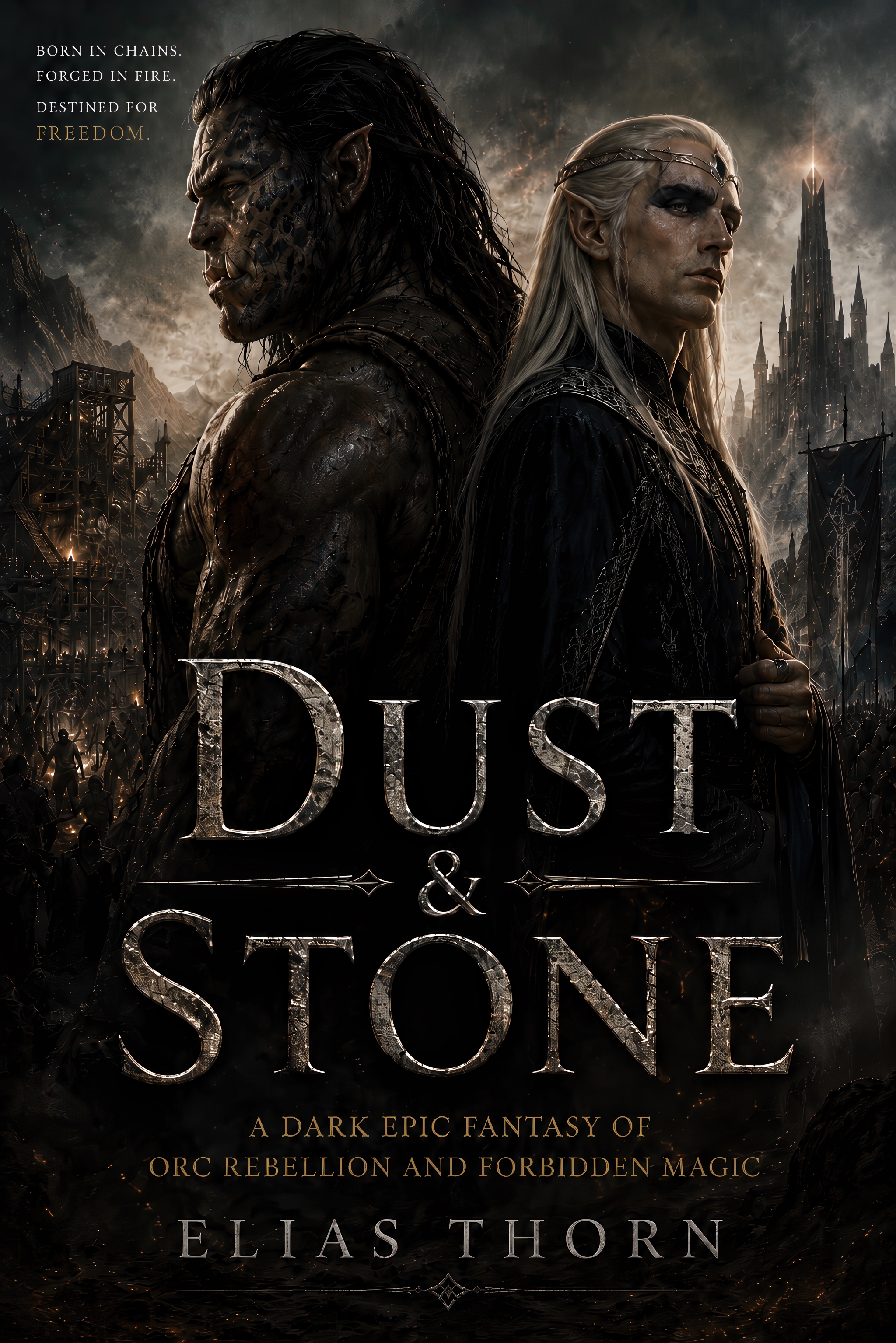
A powerful example of this shift can be found in Dust & Stone.
The novel follows the Kethri, a proud race of orcs who have spent fifty years living as slaves beneath the mountains after being conquered by the elven Dominion. Their language has been outlawed, their culture suppressed, and their freedom stolen through ancient silver magic.
Rather than portraying the orcs as villains, the story positions them as victims of conquest struggling to preserve their identity and reclaim their future.
At the center of the narrative is Vorrick, whose personal tragedy forces him to confront difficult questions about freedom, sacrifice, and leadership.
The novel demonstrates how dramatically fantasy has evolved. Instead of asking whether the orcs are evil, readers are asked to consider what happens when an entire people are denied their humanity.
👉 Learn more about Dust & Stone: https://a.co/d/0hGuId6e
Why Readers Love Nuanced Orcs
Modern fantasy readers often prefer complexity over simple moral binaries.
Stories become more engaging when characters have understandable motivations, even when their actions are flawed.
Nuanced orc characters offer several advantages:
Richer Worldbuilding
Detailed orc cultures make fantasy worlds feel larger and more believable.
Stronger Themes
Stories can explore prejudice, identity, colonization, and cultural survival in meaningful ways.
Better Characters
Readers tend to connect more deeply with fully realized individuals than with generic monsters.
Greater Emotional Impact
Conflicts become more compelling when both sides have understandable perspectives.
These factors have helped fuel the growing popularity of orc-centered fantasy.
Can Orcs Still Be Villains?
Absolutely.
Modern fantasy has not eliminated villainous orc characters. Instead, it has expanded the range of possibilities available to authors.
Some orcs remain antagonists.
Some become heroes.
Many occupy morally gray territory somewhere in between.
The difference is that contemporary fantasy usually treats villainy as a personal choice rather than an unavoidable racial trait.
This approach allows for more sophisticated storytelling and more believable characters.
The Influence of Modern Fantasy Trends
The evolution of orcs reflects broader changes within the fantasy genre.
Readers increasingly seek stories that challenge assumptions and offer fresh perspectives. Authors have responded by creating worlds where cultures are more complex and morality is less predictable.
This trend has benefited orcs more than perhaps any other fantasy race.
Characters who were once limited to supporting roles now serve as protagonists, leaders, revolutionaries, and cultural icons.
Their stories have become some of the most exciting in modern fantasy.
Why the Question Still Matters
The question “Are orcs evil?” remains popular because it touches on larger conversations about fantasy itself.
How should races be portrayed?
Can entire groups be reduced to stereotypes?
What happens when we hear only one side of a story?
Modern fantasy increasingly answers these questions by embracing complexity and encouraging readers to see the world from multiple perspectives.
In doing so, it transforms one of the genre’s oldest races into something far more interesting.
Final Thoughts
The idea that all orcs are evil no longer reflects the reality of modern fantasy literature.
Today’s authors portray orcs as diverse, complex, and fully realized characters capable of heroism, villainy, wisdom, courage, and sacrifice. Their stories explore identity, freedom, culture, and survival in ways that resonate strongly with contemporary readers.
Books like Dust & Stone exemplify this evolution by placing orcs at the center of a deeply human story about oppression, memory, and resistance. Rather than asking whether the Kethri are evil, the novel asks readers to consider what it means to fight for freedom and preserve a culture under threat.
For many fantasy fans, that question is far more interesting.
👉 Discover Dust & Stone on Amazon: https://a.co/d/0hGuId6e
Frequently Asked Questions
Are orcs always evil in fantasy?
No. Modern fantasy increasingly portrays orcs as heroes, leaders, scholars, and complex individuals rather than inherently evil monsters.
Why were orcs traditionally portrayed as villains?
Early fantasy often relied on clear distinctions between heroes and villains, and orcs frequently filled the role of antagonists.
What fantasy books feature heroic orcs?
Examples include Dust & Stone, The Grey Bastards, and Orcs by Stan Nicholls.
Is Dust & Stone told from an orc perspective?
Yes. The story follows Vorrick, a member of the Kethri, an oppressed orc civilization fighting for freedom and cultural survival.
Why are modern fantasy authors changing orc portrayals?
Readers increasingly enjoy complex characters and morally nuanced stories, encouraging authors to move beyond traditional stereotypes.
Leave a Reply